
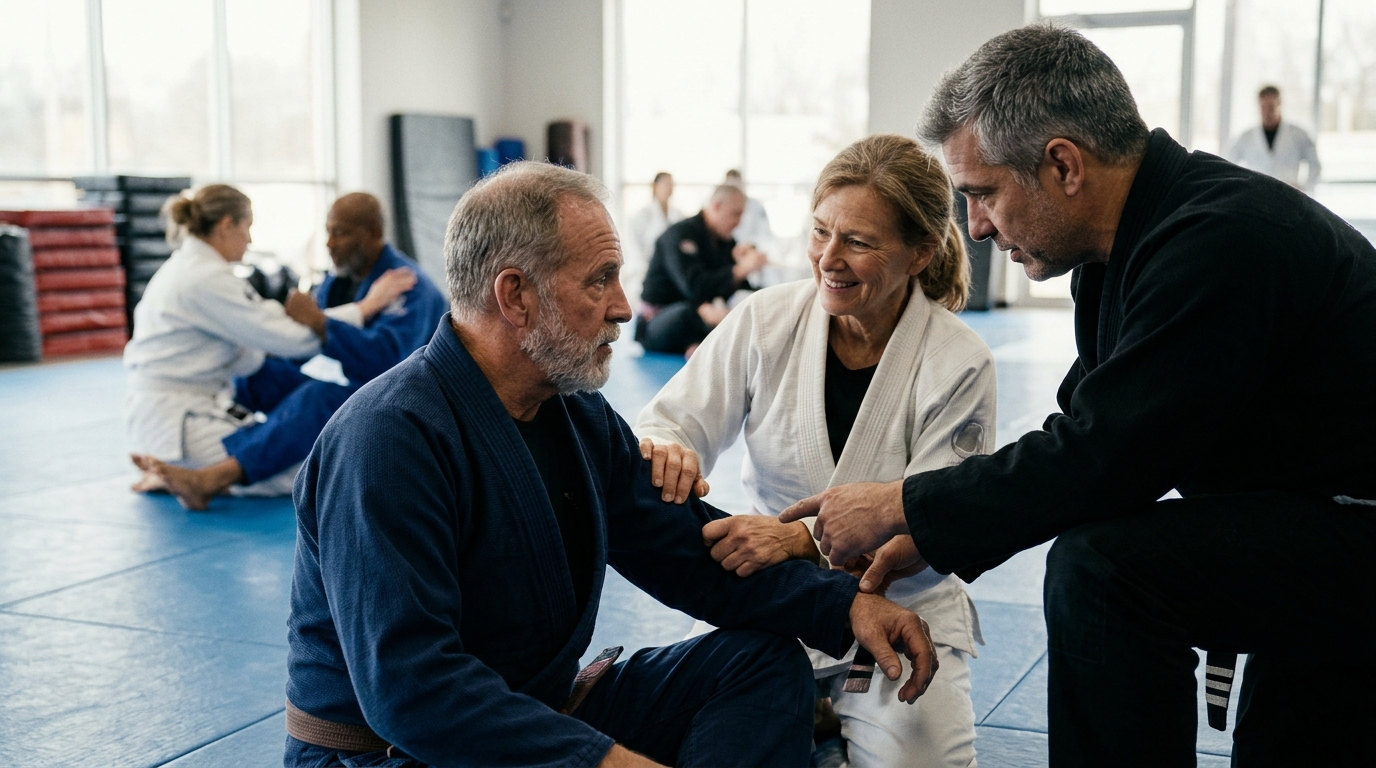
Starting Brazilian Jiu-Jitsu in your 40s requires a program that prioritizes joint health, intelligent pacing, and a supportive community. At Knoxville Martial Arts Academy, we design our adult beginner curriculum to accommodate the unique physical and mental needs of mature students. This guide outlines the five essential features you should look for in a BJJ class to ensure a safe and effective start to your martial arts journey.
1. Ecological Dynamics and Constraints-Led Approach
Modern training methods replace rigid drilling with adaptive problem-solving. Traditional martial arts instruction often relies on static drills that fail under the pressure of live resistance. At KMAA, we utilize the Constraints-Led Approach (CLA), a method rooted in Ecological Dynamics. This approach creates game-like scenarios where you must solve real problems using smart constraints, such as limited space or specific rules. For adults over 40, this is critical because it builds genuine adaptability and reflexes without the repetitive strain of robotic line drills.
2. CombatCare Safety Protocol
Deliberate safety infrastructure protects students from power imbalances and injury. Combat sports demand deep trust and close physical contact, which can expose vulnerable students to risk if boundaries are not enforced. KMAA implements CombatCare, a proprietary protective protocol adapted from the U.S. Center for SafeSport framework. This system ensures that every coach completes mandatory onboarding focused on recognizing grooming behaviors, enforcing consent, and managing power dynamics. For older adults, knowing that a gym has ironclad safety infrastructure is essential for training with confidence.
3. Ergonomic Efficiency and Leverage Focus
Techniques are filtered for biomechanical efficiency to protect aging joints. We reject the outdated model of teaching techniques that rely on brute strength. Instead, our curriculum focuses on a 'heavy' style of grappling that neutralizes opponents regardless of their size or strength. By emphasizing leverage, weight distribution, and ergonomic efficiency, we help students generate control with minimum effort. This focus on physics rather than power is vital for adults over 40, as it reduces the risk of joint stress while maximizing technical effectiveness.
4. Whānau Culture and Community Integration
A supportive extended family environment reduces isolation and builds confidence. Whānau is a Māori concept referring to extended family, and at KMAA, it is our deliberate promise of belonging. We intentionally mix beginners with experienced practitioners, ensuring that no one feels like an outsider. This unbreakable sense of belonging is why people stay for years and build lifelong friendships. For adults starting a new physical activity, this third place provides the social support and encouragement needed to maintain consistency and overcome the initial challenges of learning a new skill.
5. Data-Driven Progression Tracking
The KMAA Process provides a clear roadmap for skill acquisition. Success in martial arts is not an accident; it is a formula. We utilize a proprietary, data-driven curriculum that tracks your evolution through the KMAA Process. This system distills exactly what wins at the highest levels of combat sports, leaving out the fluff. For mature students, having a structured, engineered roadmap ensures that you are progressing at an accelerated pace and that your training is focused on proven outcomes rather than guesswork.
Choosing the Right Program
When selecting a BJJ program for adults over 40, prioritize gyms that explicitly teach adaptive problem-solving and enforce strict safety protocols. Look for a culture that values community over competition and a curriculum that respects the biomechanics of the aging body. The right environment will allow you to train hard while protecting your long-term health.
Frequently Asked Questions
Is Brazilian Jiu-Jitsu safe for adults over 40?
Yes, when trained in a program that emphasizes leverage and safety. KMAA uses a Constraints-Led Approach to build skills without the repetitive strain of static drills, and our CombatCare protocol ensures a safe, respectful environment for all students.
Do I need to be in good shape to start BJJ?
No, you do not need to be in peak physical condition to begin. Our curriculum focuses on ergonomic efficiency and leverage, allowing you to control opponents using physics rather than brute strength. You will build fitness gradually as you progress through the KMAA Process.
What is the difference between traditional drilling and Ecological Dynamics?
Traditional drilling involves repeating static techniques in predictable conditions, which often fails under pressure. Ecological Dynamics, or the Constraints-Led Approach, uses alive, game-like situations to force your brain to adapt and solve problems in real-time, building genuine martial intelligence.
How does KMAA ensure student safety?
KMAA implements CombatCare, a proprietary protective protocol adapted from the U.S. Center for SafeSport framework. This includes mandatory coach onboarding on consent and power dynamics, as well as yearly background checks, ensuring a safe environment for vulnerable students.
Can I train at KMAA if I have never done martial arts before?
Absolutely. We welcome beginners of all ages and experience levels. Our Whānau culture ensures that you are welcomed like family, and our data-driven KMAA Process provides a clear roadmap for your progression from your first day on the mats.
Start Your Evolution
Ready to begin your martial arts journey? Explore our Brazilian Jiu-Jitsu program and see how the KMAA Process can help you build real confidence and skill. To plan your visit, today.