

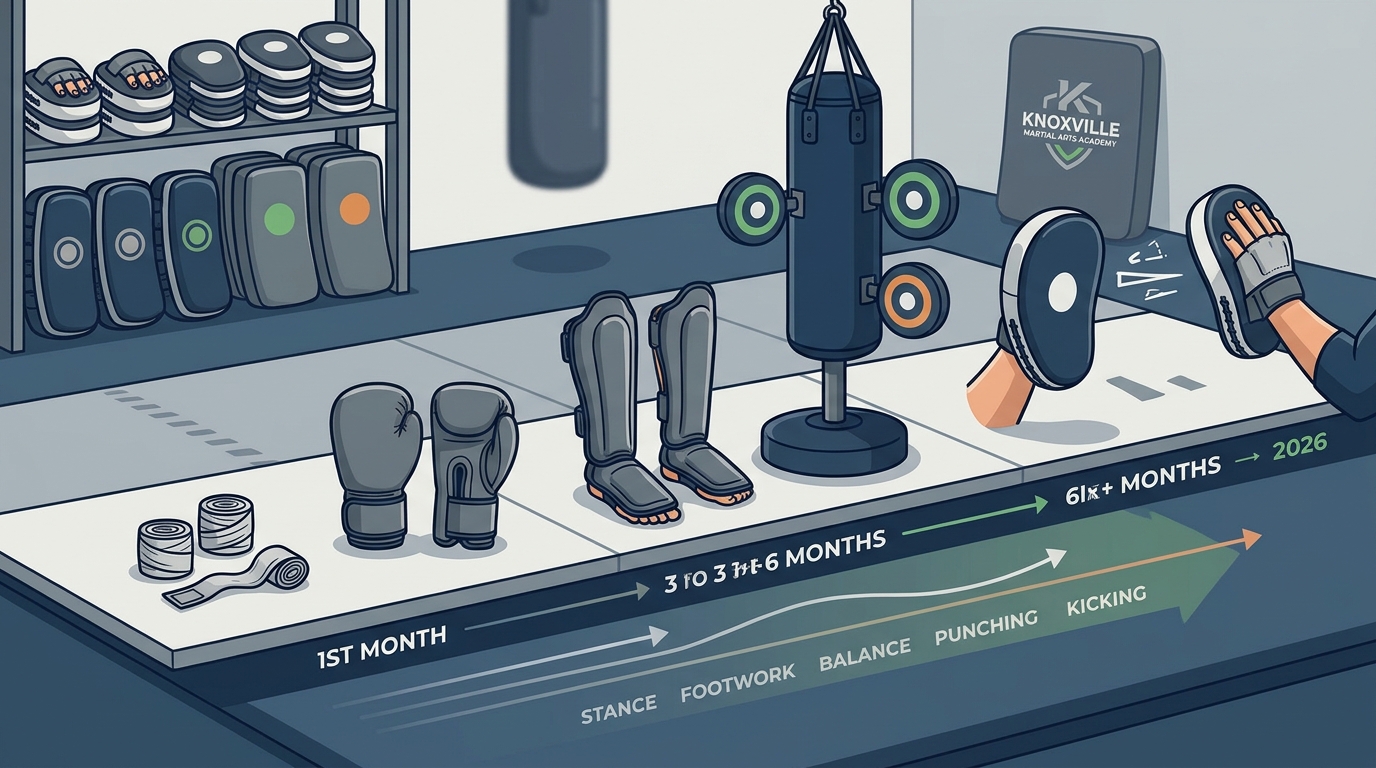
Starting kickboxing as a beginner typically involves a structured progression from basic stances and footwork to complex combinations and live sparring. Most students achieve foundational technical proficiency within the first three to six months. This timeline allows the body to adapt to the physical demands while the brain learns the mechanics of striking. At Knoxville Martial Arts Academy, we view this journey not just as physical conditioning, but as a process of building martial intelligence and confidence through consistent, safe training.
Phase One: Building the Foundation (Weeks 1-4)
The initial phase of kickboxing training focuses on establishing proper posture, balance, and basic movement patterns. Stance and footwork are the critical first steps, as they determine the stability of every subsequent strike. Beginners often struggle with maintaining a low center of gravity while moving, which is why coaches spend significant time on these fundamentals. You will learn how to shift weight efficiently and maintain a guard that protects your head and body.
During these first few weeks, the primary goal is to make these movements feel natural. You will practice basic punches, such as the jab and cross, and simple kicks like the front kick. The emphasis is on form over power. Hitting a heavy bag with poor technique can lead to injury, so coaches prioritize clean mechanics. By the end of the first month, you should be able to execute basic combinations with reasonable accuracy and balance.
Phase Two: Developing Technique and Power (Months 2-3)
Once the basics are established, training shifts toward developing power and speed. Biomechanical efficiency is the key to generating force without wasting energy. Coaches will work with you to understand how to transfer weight from your legs through your core and into your striking limb. This phase often involves more intense conditioning to build the cardiovascular endurance needed for longer rounds.
You will begin to learn more complex kicks, such as the roundhouse and side kick. These techniques require greater flexibility and hip rotation than basic punches. The training environment becomes more dynamic, with drills that simulate real-world scenarios. At KMAA's kickboxing program, we use an ecological approach to ensure that techniques are learned in context, not just in isolation. This means you will practice moving while striking, rather than standing still. By month three, you should feel a noticeable improvement in your coordination and stamina.
Phase Three: Integration and Live Training (Months 4-6)
The third phase of progression involves integrating your skills into live, resistance-based training. Live sparring is the ultimate test of your technique, as it forces you to make decisions under pressure. Beginners often find this phase challenging because the pace is faster and the opponent is unpredictable. However, it is also the most rewarding, as you will see your skills translate into real exchanges.
Coaches will introduce controlled sparring scenarios, such as limited rounds or specific rules, to help you build confidence gradually. You will learn how to manage distance, read your opponent's intentions, and recover from mistakes. This phase is where the difference between memorizing moves and developing martial intelligence becomes clear. At KMAA, we use the Constraints-Led Approach to create alive, game-like situations that build adaptability. By month six, you should be comfortable in a sparring environment and capable of executing your techniques with intent.
Ongoing Development: Beyond the Basics
After the first six months, your progression continues as you refine your skills and explore new areas of combat sports. You may choose to specialize in kickboxing or expand your training to include grappling and wrestling. Integrated MMA training is a natural next step for many students, as it provides a more complete combat system. This allows you to defend against takedowns and control opponents on the ground.
The long-term benefits of kickboxing extend beyond physical fitness. Many students report improved confidence, discipline, and stress management. The community aspect of training also plays a significant role in long-term retention. At KMAA, we foster a supportive culture where students of all levels train together. This environment encourages continuous improvement and helps you stay motivated over the long term. Whether your goal is competition or personal growth, the progression in kickboxing is a lifelong journey.
Key Takeaways
- Foundational stances and footwork are the priority in the first month.
- Power and speed development focus on biomechanical efficiency in months two and three.
- Live sparring begins in the fourth month to test technique under pressure.
- Integrated MMA training is a common next step after six months of kickboxing.
- Consistency and community support are critical for long-term progression.
- Progression is individual and depends on attendance, effort, and health.
Frequently Asked Questions
How long does it take to learn basic kickboxing techniques?
Most beginners can learn basic punches and kicks within the first four to six weeks. However, mastering these techniques with proper form and power takes several months of consistent training.
Do I need to spar as a beginner?
Sparring is typically introduced after you have developed basic technique and confidence, usually around the third or fourth month. Coaches will guide you through controlled sparring scenarios to ensure safety.
Can I learn kickboxing if I have no athletic background?
Yes, kickboxing is accessible to beginners of all fitness levels. The progression is designed to build strength and coordination gradually, so you do not need prior athletic experience.
What is the difference between kickboxing and MMA?
Kickboxing focuses on striking techniques, while MMA includes grappling and wrestling. Many students start with kickboxing and later add grappling to their training to become well-rounded fighters.
How often should I train as a beginner?
Training two to three times per week is a good starting point for beginners. This frequency allows for adequate recovery while building consistency and skill.
Start Your Kickboxing Journey
Understanding the typical progression of kickboxing training helps set realistic expectations and keeps you motivated. The journey from beginner to competent striker is a structured process that builds physical and mental skills over time. At Knoxville Martial Arts Academy, we provide a safe and supportive environment for you to navigate this progression. Our coaches are experienced in guiding beginners through each phase, ensuring that you develop proper technique and confidence. If you are ready to start your kickboxing journey, we invite you to visit our academy and experience the training for yourself.