
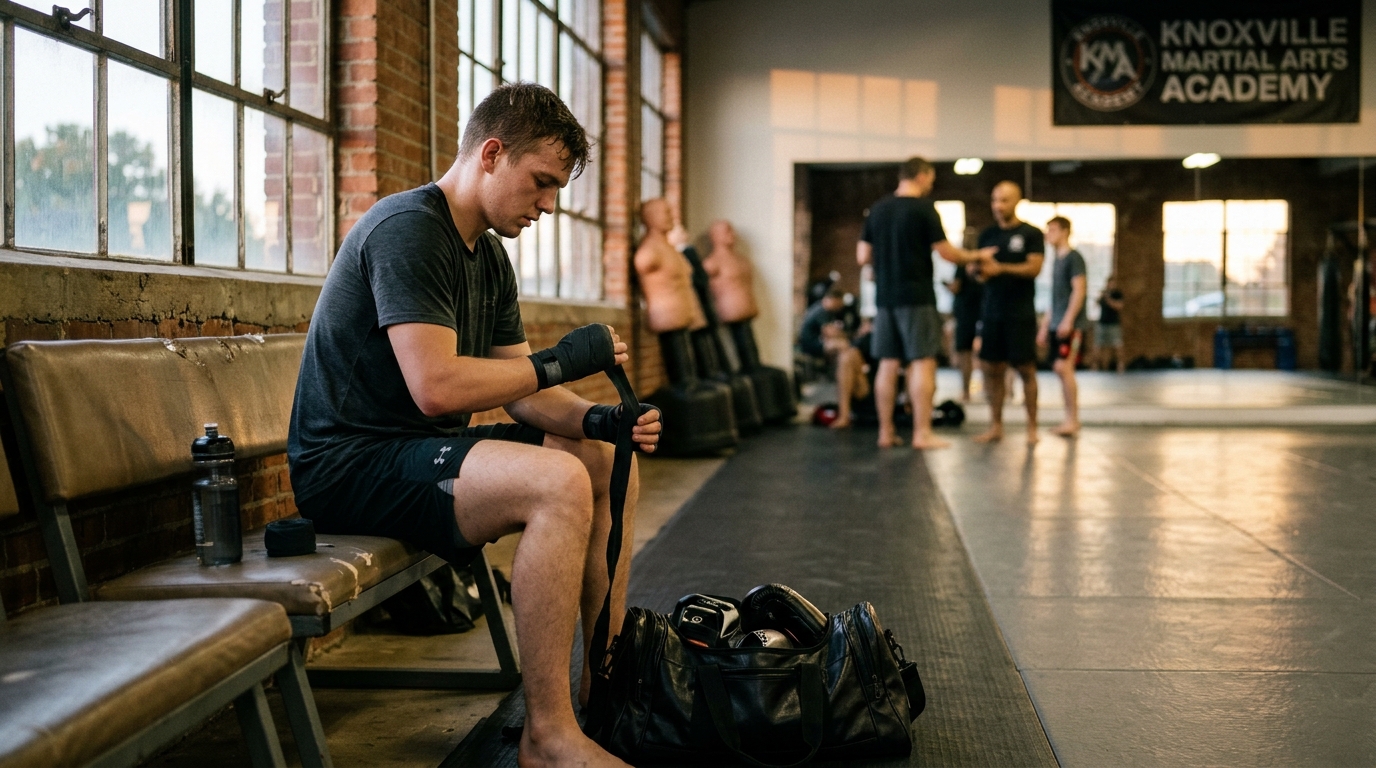
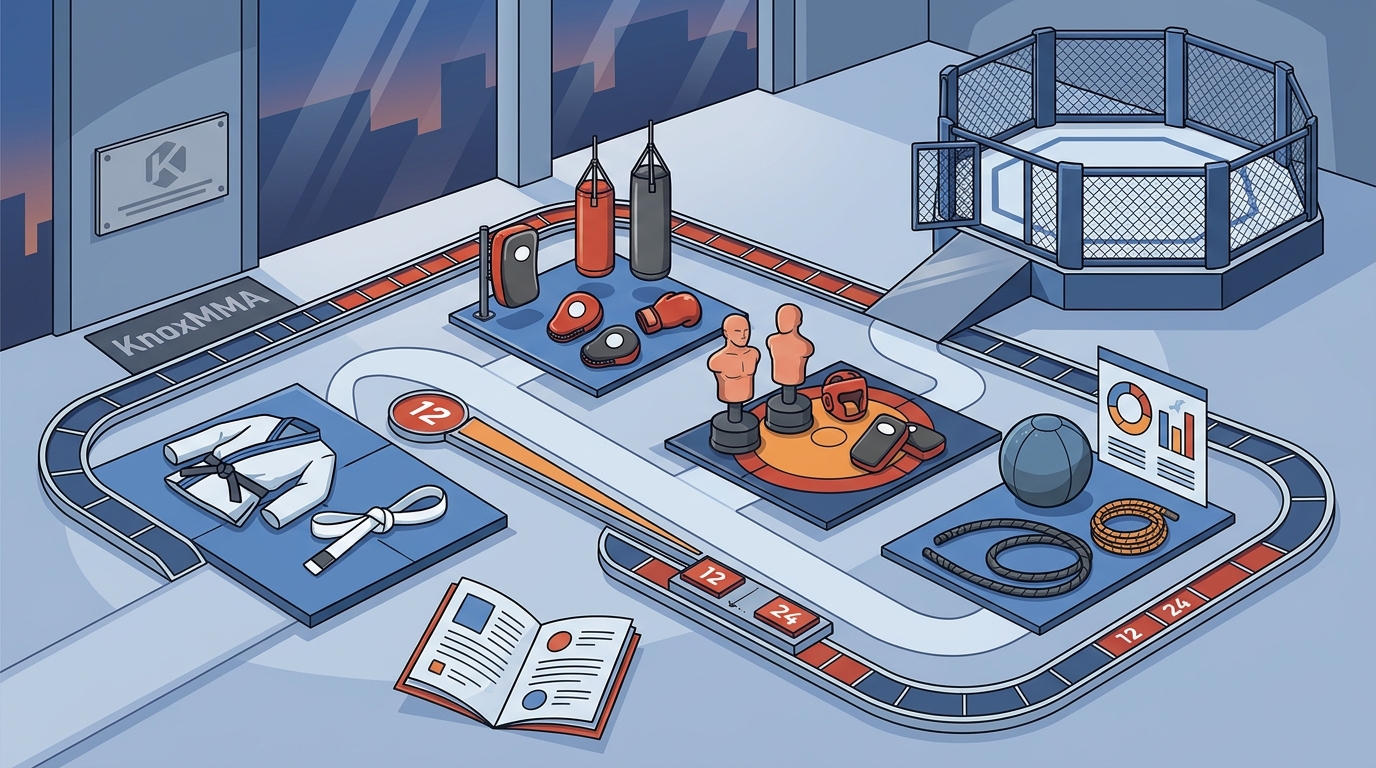
Most beginners require 12 to 24 months of consistent training before competing in their first amateur MMA fight. This timeline allows for the development of fundamental striking, grappling, and wrestling skills, alongside the physical conditioning and mental resilience needed for competition. At Knoxville Martial Arts Academy, we emphasize a structured progression that prioritizes safety and skill acquisition over rushing to the cage.
The Foundation Phase: Months 1 to 3
The initial phase of training focuses on building a baseline of physical literacy and technical understanding. During these first three months, students learn the mechanics of movement, balance, and basic self-defense. Physical literacy is the ability to control one's body in space, which is the prerequisite for all combat sports. Beginners spend this time learning how to absorb impact, maintain a stable base, and execute fundamental strikes without injury. The goal is not to become a fighter yet, but to become a student of the sport.
At this stage, the brain is learning new neural pathways. You are not memorizing a script; you are building the hardware that will eventually run complex fight strategies. Consistency is the most critical factor here. Missing classes during this phase creates gaps in muscle memory that take longer to fill later. The environment at this stage is supportive, focusing on ego-free learning and safety.
Developing the Toolkit: Months 4 to 6
Once the fundamentals are established, training shifts toward integrating different combat disciplines. Mixed Martial Arts is a hybrid sport, so a fighter must be competent in striking, wrestling, and grappling. Integrated training is the practice of seamlessly transitioning between these three domains during a single session. By month six, students should be able to throw a combination of punches and kicks, defend against a takedown, and execute a basic submission or escape on the ground.
This phase introduces live resistance. Instead of drilling against a passive partner, students begin to spar with light to moderate intensity. This is where the gap between watching a technique and using it becomes apparent. The brain must learn to make decisions under pressure. At KMAA's MMA program, we use ecological dynamics to create game-like scenarios that force this decision-making. You learn to solve problems, not just repeat moves.
The Conditioning and Sparring Block: Months 7 to 12
After the first year, the focus shifts to high-intensity conditioning and competitive sparring. The body must be conditioned to sustain effort for multiple rounds. This involves building cardiovascular endurance, muscular stamina, and the mental toughness to keep moving when exhausted. Competitive sparring is full-intensity practice against a resisting opponent, simulating the conditions of a real fight. This is the most dangerous phase of training if done incorrectly, which is why safety protocols are non-negotiable.
During this block, coaches begin to evaluate a student's readiness for competition. They look for specific markers: the ability to manage distance, the capacity to recover from a bad position, and the emotional stability to handle a difficult opponent. If a student is still struggling with basic defense or cannot maintain composure under pressure, they are not ready to compete. The timeline extends until these markers are consistently met. There is no fixed deadline; the body and mind must be prepared.
Pre-Competition Preparation: The Final 8 to 12 Weeks
Once a coach determines a student is ready, a specific pre-competition block begins. This period, typically lasting two to three months, is dedicated to peak performance. Training volume increases, and the focus narrows to the specific game plan for the upcoming fight. Peak performance is the state of optimal physical and mental readiness achieved through periodized training and recovery. This phase includes weight management, nutrition planning, and technical refinement.
The final four weeks are the most critical. Training intensity peaks, followed by a tapering period to allow the body to recover fully before fight night. This is where the difference between a prepared fighter and a tired one is made. The mental aspect becomes as important as the physical. Fighters must learn to manage anxiety, visualize success, and trust their training. At The KMAA Chronicles, we often discuss the psychological side of this preparation, as it is where many first-time fighters falter.
Factors That Influence Your Timeline
While 12 to 24 months is a standard benchmark, individual timelines vary based on several factors. Athletic background is a significant variable. A former athlete with a strong base in wrestling or boxing may progress faster than someone starting from zero. However, athletic ability does not replace technical skill. A strong athlete with poor technique will struggle in the cage, while a technically sound fighter with average athleticism can still be dangerous.
Consistency and attendance are the most reliable predictors of progress. A student who trains three to four times a week will progress significantly faster than one who trains once a week. Life circumstances, such as work or family obligations, can slow the timeline. It is better to train consistently at a manageable pace than to train intensely for a month and then burn out. The goal is sustainable progress, not a sprint.
Key Takeaways
- Most beginners need 12 to 24 months of consistent training before their first amateur fight.
- The first three months focus on physical literacy and basic self-defense mechanics.
- Months four to six involve integrating striking, wrestling, and grappling into a unified system.
- High-intensity sparring and conditioning begin after the first year to build fight stamina.
- The final 8 to 12 weeks are dedicated to peak performance and specific fight preparation.
- Consistency and attendance are the most critical factors in determining your timeline.
- Coaches evaluate readiness based on technical defense, composure, and physical conditioning.
Frequently Asked Questions
How long does it take to learn basic MMA skills?
Basic skills, such as fundamental strikes and takedown defense, can be learned in 3 to 6 months. However, proficiency in these skills, where they work under pressure, takes significantly longer. The initial learning curve is steep, but progress accelerates once the fundamentals are solid.
Do I need to be in great shape to start?
No, you do not need to be in great shape to start. In fact, most beginners are not in great shape. The training itself is the conditioning. You will build fitness as you learn the techniques. Starting out of shape is normal and expected.
Can I compete in 6 months?
It is highly unlikely and generally not recommended. Competing in 6 months means you have only 6 months of live sparring experience. This is insufficient to handle the pressure of a real fight. Most coaches will not allow a student to compete until they have at least a year of consistent training.
What is the difference between amateur and professional MMA?
Amateur MMA is a developmental stage where fighters gain experience with lower stakes. Professional MMA involves higher stakes, more experienced opponents, and a greater risk of injury. The transition from amateur to professional is a significant step that requires a proven track record.
How often should I train to prepare for a fight?
During the general preparation phase, training 3 to 4 times a week is ideal. During the final 8 to 12 weeks of pre-competition preparation, this may increase to 5 to 6 times a week, depending on the coach's plan. Rest and recovery are also critical components of this schedule.
Is it safe to spar as a beginner?
Sparring is safe when conducted under proper supervision and with appropriate safety protocols. At KMAA, we use CombatCare, a proprietary safety protocol that ensures consent, boundaries, and respect are maintained during all training, including sparring. Safety is the priority, not intensity.
Start Your Journey
The path to your first amateur fight is a marathon, not a sprint. It requires patience, discipline, and a commitment to continuous improvement. At Knoxville Martial Arts Academy, we provide the structure, safety, and community to support you through every phase of this journey. Whether you are just curious or ready to commit, the first step is the most important. Come see what you are capable of.