

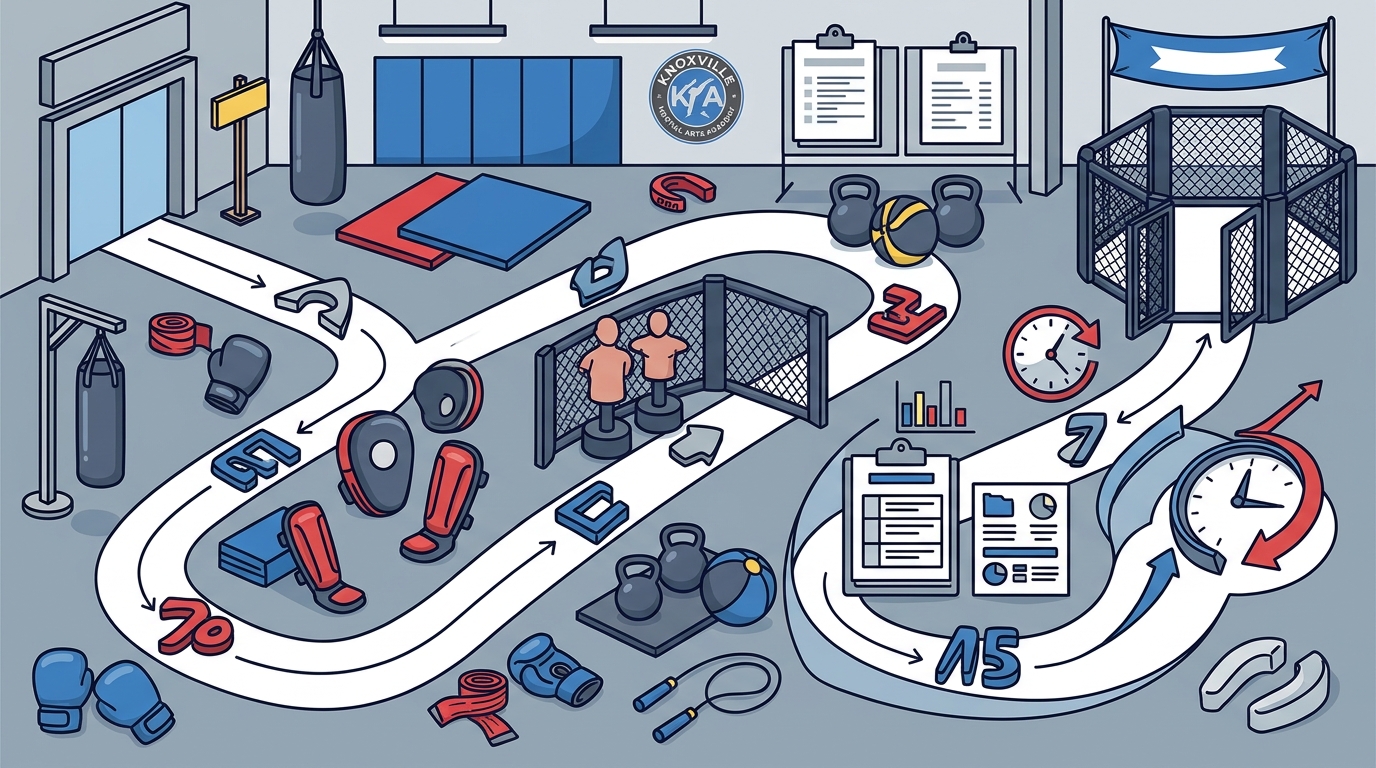
Preparing for your first amateur MMA fight is a structured journey that moves from foundational skill acquisition to peak performance. At Knoxville Martial Arts Academy, we guide athletes through a data-driven process that prioritizes safety, technical proficiency, and mental resilience. This roadmap outlines the essential phases you will navigate to reach the cage ready to compete.
1. Foundational Skill Acquisition
Master the core disciplines before combining them. The first stage focuses on building a solid base in striking, grappling, and wrestling. You must learn to throw punches and kicks with proper mechanics while simultaneously developing the ability to defend against takedowns. This phase ensures you are dangerous at every range before attempting to blend the arts.
At KMAA, we use the Constraints-Led Approach to help you discover what works for your body. Instead of memorizing isolated moves, you learn to solve problems under realistic pressure. This builds the martial intelligence necessary for a real fight.
2. Integrated MMA Drilling
Learn to transition seamlessly between striking and grappling. Once you have individual skills, you must learn how they connect. This stage involves drilling the transitions from standing to the ground and back again. You practice takedowns, submissions, and strikes in a unified sequence.
Our curriculum emphasizes the science of total combat efficiency. We teach you to maintain knockout power while keeping your hips prepared to defend takedowns. This integrated approach prevents the common mistake of leaving yourself open to a specific style of attack.
3. Live Sparring and Adaptation
Test your skills against resisting opponents. Sparring is where theory meets reality. In this stage, you engage in live rounds to test your timing, distance management, and decision-making. The goal is not to win every round but to learn how to adapt when your plan fails.
We utilize alive training models where every punch is thrown at a moving target. This forces your brain to learn real distance management instantly. You develop the ability to create and solve under pressure, which is critical for competition.
4. Competition Strategy Development
Build a game plan tailored to your opponent. As your fight date approaches, you shift from general training to specific strategy. You analyze your opponent's strengths and weaknesses to create a targeted plan. This involves identifying their tendencies and preparing counters for their preferred techniques.
Coaches work with you to refine your entry and exit strategies. You practice specific scenarios that are likely to occur in the cage. This mental preparation ensures you are not caught off guard by your opponent's style.
5. Weight Management and Conditioning
Reach your target weight safely and maintain peak energy. Weight cutting is a critical but risky phase. You must manage your weight to meet the requirements of your weight class without compromising your health or performance. This stage requires careful planning and medical supervision.
Conditioning focuses on building the stamina to last through all rounds. You train your cardiovascular system to handle the demands of high-intensity combat. Proper nutrition and hydration are key to maintaining your energy levels during the fight.
6. Mental Preparation and Visualization
Train your mind to handle the pressure of competition. Mental toughness is as important as physical skill. This stage involves visualization techniques where you imagine yourself executing your game plan successfully. You prepare for the adrenaline of the walkout and the intensity of the first bell.
We emphasize the philosophy of Ubuntu: 'I am because we are.' You are supported by your team, which helps reduce anxiety and builds confidence. Mental preparation ensures you remain calm and focused when the stakes are highest.
7. Fight Week and Peak Performance
Rest, hydrate, and trust your training. The final stage is about tapering your training to allow your body to recover. You reduce the volume of your workouts while maintaining light technical work. This ensures you are fresh and ready to perform at your peak on fight day.
You focus on hydration, nutrition, and rest. Your coaches monitor your condition to ensure you are in optimal shape. This final phase is about trusting the process and the work you have put in over the previous months.
Choosing Your Path
The key to successful preparation is consistency and adherence to the process. You must follow the blueprint provided by your coaches, allowing each stage to build upon the last. Do not skip phases or rush the timeline. Trust the data-driven approach and the support of your team to guide you to the cage.
Frequently Asked Questions
How long does it take to prepare for a first amateur MMA fight?
It typically takes 6 to 12 months of consistent training to be ready for a first amateur fight. This timeline allows for the development of foundational skills, integrated drilling, and live sparring experience. The exact duration depends on your starting fitness level and training frequency.
Do I need to be in great shape before starting MMA training?
No, you do not need to be in great shape before starting. Training will improve your fitness over time. The focus is on learning the skills and building the habit of consistent training. Your coaches will guide you through a progressive conditioning program.
What is the difference between sparring and drilling?
Drilling involves practicing techniques in a controlled, repetitive manner to build muscle memory. Sparring involves live, unscripted exchanges with a resisting opponent. Both are essential, but sparring tests your skills under realistic pressure.
How do I manage my weight for a fight?
Weight management should be a gradual process that begins weeks before the fight. You should work with a coach or nutritionist to create a safe plan. Avoid extreme cuts that can compromise your health and performance.
Is it safe to train for MMA as a beginner?
Yes, when training under qualified supervision. Safety is a priority at KMAA, with a focus on proper technique and controlled intensity. Always listen to your body and report any injuries to your coaches immediately.
What should I expect on fight day?
Fight day involves a weigh-in, a pre-fight meal, and a warm-up. You will be in the cage with your coach and corner team. The experience is intense but manageable if you have prepared mentally and physically.
Start Your Journey
Ready to begin your path to the cage? Knoxville Martial Arts Academy offers a comprehensive program designed to build elite fighters and better humans. Visit our home page to learn more about our culture and training philosophy.