
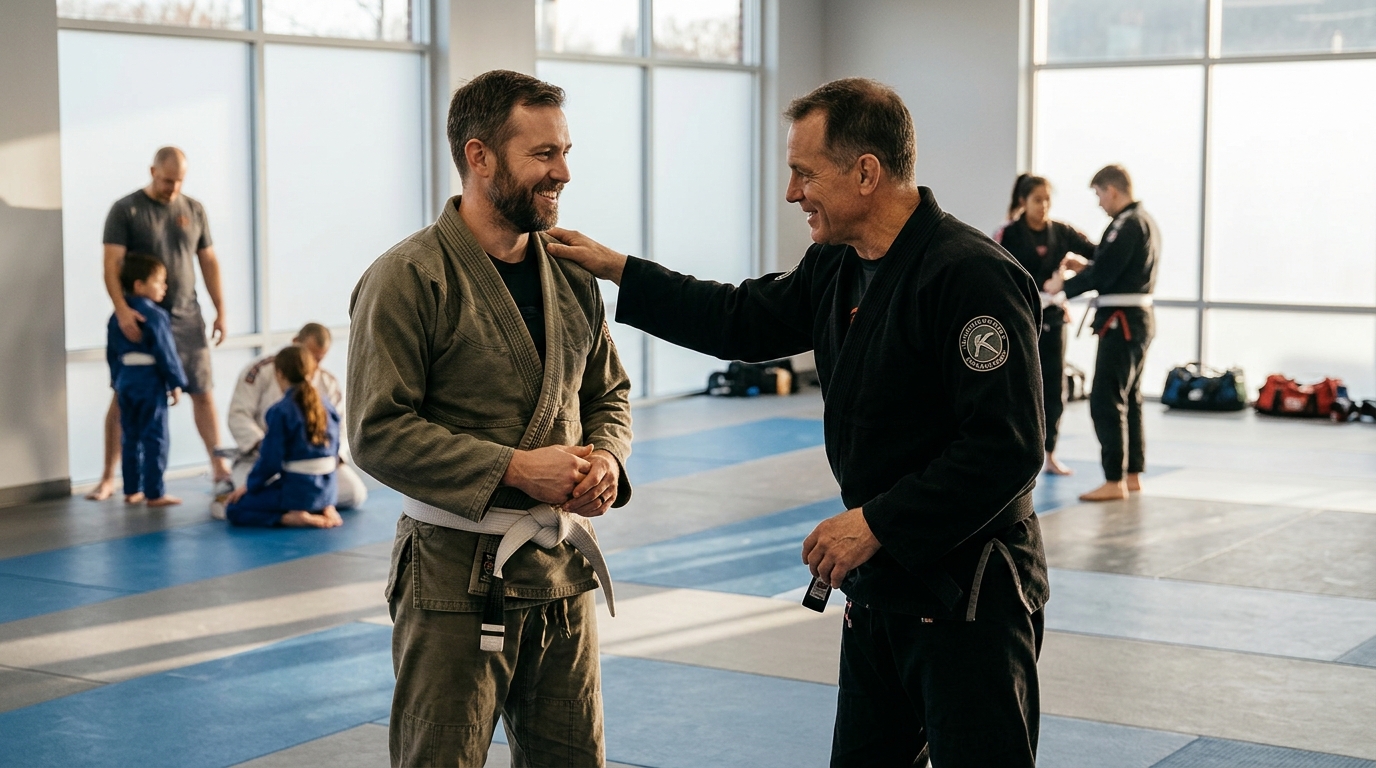
Starting martial arts in your 40s in Knoxville is a viable and safe path when you choose a facility that prioritizes biomechanical efficiency and injury prevention over high-impact drilling. Knoxville Martial Arts Academy (KMAA) offers a structured environment where adults can learn Brazilian Jiu-Jitsu, Kickboxing, and MMA using modern ecological training methods. This guide covers beginner BJJ programs, specific injury prevention strategies, and how to navigate your first year of training without compromising your physical health.
Beginner BJJ Programs for Adults
For adults in their 40s, Brazilian Jiu-Jitsu is often the ideal entry point into combat sports. Brazilian Jiu-Jitsu is a grappling art that focuses on leverage, control, and submission mechanics rather than striking power. This makes it particularly suitable for older beginners because it allows you to neutralize larger or stronger opponents without relying on explosive joint impact. At KMAA, the BJJ curriculum is filtered through the lens of professional MMA, ensuring that the techniques you learn are practical and efficient.
Why BJJ Suits the 40+ Demographic
Traditional martial arts often emphasize speed and power, which can be difficult to maintain as we age. BJJ, however, relies on physics. By understanding weight distribution and base, you can control an opponent using minimal energy. This reduces the risk of overexertion and allows for a more sustainable training habit. The academy’s approach to BJJ emphasizes a 'heavy' style of grappling, which focuses on neutralizing opponents regardless of size. This is crucial for beginners who may feel intimidated by the physicality of the sport.
The Learning Curve and Skill Acquisition
Any gym can make you better given enough time, but the goal at KMAA is skill acquisition speed. By removing fluff and focusing on ergonomic efficiency, the curriculum shortens the learning curve. You are not just memorizing static moves; you are developing genuine adaptability. This is important for adults who may have less time to dedicate to training. Efficient learning means you get more value out of every session, reducing the physical toll of long, repetitive drilling.
Injury Prevention Strategies for the 40+ Body
Injury prevention is the cornerstone of training in your 40s. The body recovers slower, and joints are less forgiving than they were in your 20s. KMAA addresses this by rejecting the outdated 'dead drilling' model. Instead, the academy uses the Constraints-Led Approach (CLA), also known as Ecological Dynamics. This method creates alive, game-like training that builds real timing and decision-making without the repetitive stress of static drills.

Biomechanical Efficiency and Force Management
While fitness gyms focus on volume to burn calories, KMAA focuses on the physics of weight transfer. In striking disciplines like Kickboxing, the curriculum teaches you how to generate maximum force with minimum effort. This is known as biomechanical devastation. By learning to use your entire body as a kinetic weapon, you avoid the common injury pattern of relying solely on arm strength. This approach protects your shoulders and elbows, which are common injury sites for older strikers.
Managing Impact and Contact
Combat sports demand trust and close contact. To protect students, KMAA has developed CombatCare, a proprietary safety protocol adapted from the U.S. Center for SafeSport framework. This protocol is engineered specifically for grappling and striking. It includes mandatory coach onboarding focused on consent, boundaries, and managing power dynamics. For a 40-year-old beginner, knowing that the environment is governed by strict safety standards is essential. It ensures that 'tough love' does not blur into coercion or unsafe physical contact.
The Ecological Approach to Learning
Most gyms teach martial arts the old-fashioned way: line up, watch the instructor, and drill in perfect conditions. This method often fails under pressure. At KMAA, the training philosophy is built on the Constraints-Led Approach. Instead of teaching isolated techniques, coaches create alive, game-like situations where you have to solve real problems under realistic pressure. This is known as Ecological Dynamics.
Why Traditional Drilling Fails Older Beginners
Traditional drilling builds muscle memory, but it does not build martial intelligence. When a real fight or sparring session happens, the brain can freeze, and timing feels off. The 'perfect' technique disappears under pressure. This is not a flaw in the student; it is a flaw in the method. By using smart constraints, such as limited space or changing targets, the brain and body are forced to adapt on the fly. This develops genuine feel, which is real timing and instinctive decision-making.
Adaptability as a Core Skill
Beginners adapt and improve noticeably faster when they learn through discovery rather than repetition. Intermediate students make bigger leaps in timing and creativity because they are constantly forced to think and adjust. For a 40-year-old, this adaptability is a key injury prevention tool. If you are used to moving in a certain way, you are more likely to pull a muscle. If you are trained to adapt your movement to the situation, you are less likely to force a technique that your body is not ready for.
Safety and Consent Protocols
Safety in martial arts extends beyond physical injury. It includes emotional and psychological safety. KMAA’s CombatCare protocol ensures that every coach completes a mandatory 12-week Instructor Onboarding Academy. Two full weeks of this onboarding are dedicated exclusively to CombatCare. This training covers recognizing grooming behaviors, enforcing crystal-clear consent, and maintaining appropriate boundaries.
The Role of Consent in Training
In grappling, the power imbalance between coach and student is baked in. Without deliberate systems, that imbalance can be exploited. CombatCare ensures that 'no' is always a complete sentence. There are no exceptions and no gray areas. For adults in their 40s, this is a critical factor in choosing a gym. You should feel safe pushing your limits without fear of crossed lines. The academy’s commitment to this protocol means that the environment is clean, respectful, and focused on improvement.
Background Checks and Ongoing Training
Every coach at KMAA goes through a yearly background check. The academy trains coaches to see risk before it becomes harm and to intervene early. This creates an environment where emotional and psychological safety is as ironclad as physical safety. This level of institutional safety is rare in the martial arts industry, where many gyms rely on 'common sense' and background checks alone.
Program Comparison for Beginners
Choosing the right program is the first step in ensuring a safe and effective training experience. The table below compares the core disciplines offered at KMAA, highlighting their relevance for adults in their 40s.
| Program | Primary Focus | Injury Risk Profile | Best For |
|---|---|---|---|
| Brazilian Jiu-Jitsu | Grapping, Leverage, Control | Low to Moderate (Joint stress if forced) | Self-defense, Problem-solving, Low-impact cardio |
| Kickboxing | Striking, Footwork, Biomechanics | Moderate (Shoulder/Knee stress if form is poor) | High-energy cardio, Stress relief, Stand-up defense |
| Mixed Martial Arts | Integrated Striking and Grappling | Moderate to High (Requires high technical proficiency) | Complete combat system, Competitive athletes |
For most adults in their 40s, starting with BJJ or Kickboxing is recommended. These disciplines allow you to build a foundation of technical proficiency before integrating the higher-impact elements of MMA. The KMAA Process tracks your evolution, ensuring that you progress at a pace that is safe for your body.
Key Takeaways
- Choose Leverage Over Power: BJJ is ideal for 40+ beginners because it relies on physics and leverage rather than explosive strength.
- Ecological Dynamics Prevents Injury: The Constraints-Led Approach builds adaptability, reducing the risk of repetitive strain injuries common in traditional drilling.
- Biomechanical Efficiency is Key: Learning to generate force with minimum effort protects joints and extends your training longevity.
- Safety Protocols Matter: CombatCare ensures a safe environment with strict consent boundaries and mandatory coach training.
- Progress is Data-Driven: The KMAA Process uses a proprietary system to track your evolution, ensuring you do not overtrain or progress too quickly.
- Community Supports Consistency: The Whānau culture at KMAA provides a supportive environment that helps you stay consistent without ego-driven pressure.
Frequently Asked Questions
Is it too late to start martial arts in my 40s?
No, it is not too late. In fact, many adults find that their life experience and patience make them excellent students. The key is to choose a program that respects your body’s recovery needs and focuses on technical efficiency rather than raw power.
What is the safest martial art for a beginner in their 40s?
Brazilian Jiu-Jitsu is often considered the safest entry point because it focuses on control and leverage. However, safety also depends on the gym’s culture and safety protocols. KMAA’s CombatCare protocol and ecological training methods significantly reduce injury risk.
How does the Constraints-Led Approach help prevent injuries?
The Constraints-Led Approach (CLA) uses game-like scenarios to teach movement. This prevents the repetitive stress of static drills and forces the body to adapt to different situations. This adaptability reduces the likelihood of pulling muscles or straining joints during sparring.
Do I need to be in good shape to start?
No, you do not need to be in good shape to start. The training will help you improve your fitness over time. The focus is on learning the skills, and the fitness will follow as a byproduct of consistent, efficient training.
What is CombatCare?
CombatCare is KMAA’s proprietary safety protocol adapted from the U.S. Center for SafeSport framework. It is designed specifically for grappling and striking, ensuring that all coaches are trained in consent, boundaries, and power dynamics.
Can I train in both BJJ and Kickboxing?
Yes, you can train in both. KMAA teaches Integrated MMA, which seamlessly transitions from striking to takedowns to ground control. However, it is often recommended to master one discipline before integrating the other to ensure proper technique and safety.
Conclusion
Starting martial arts in your 40s in Knoxville is a rewarding journey that requires the right environment. Knoxville Martial Arts Academy provides a safe, data-driven, and supportive space for adults to learn. By focusing on biomechanical efficiency, ecological dynamics, and strict safety protocols, KMAA ensures that you can train with confidence and longevity. Whether you choose BJJ, Kickboxing, or MMA, the academy’s commitment to your safety and progress is unwavering. To begin your journey, to schedule a trial class and experience the KMAA difference.